WesternU researchers publish PIEZO2 findings in Nature Chemical Biology
by Rodney Tanaka
June 3, 2026
Read 1 mins
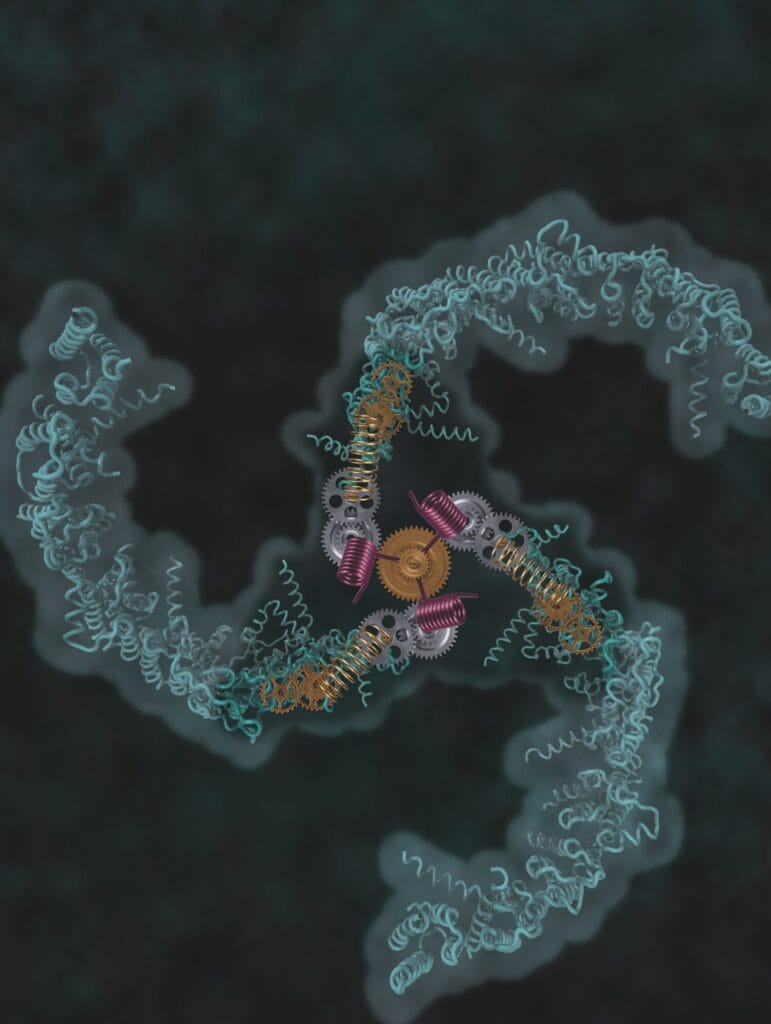
Western University of Health Sciences College of Pharmacy Professor Yun (Lyna) Luo, PhD, and College of Osteopathic Medicine of the Pacific Associate Professor Jérôme J. Lacroix, PhD, recently published their research in Nature Chemical Biology revealing how the mechanosensitive ion channel PIEZO2 activates in response to stretching forces produced by a cell membrane under tension.
Citation: Li, S., Wijerathne, T., Bhatt, A. et al. A two-step clockwork mechanism opens a proteo-lipidic pore in PIEZO2. Nat Chem Biol (2026). https://doi.org/10.1038/s41589-026-02147-8
Mechanosensitive ion channels PIEZO1 and PIEZO2 respond to mechanical deformations of the cellular membrane by opening cation-selective pores, producing electrical signals essential to numerous biological processes including blood pressure regulation, tactile sensations, and proprioception. PIEZO channels share a unique bowl-shaped homotrimeric structure, encompassing a central pore circled by three large transmembrane domains that deform the surrounding lipid bilayer.
Studies on PIEZO1 have shown that these curved domains, called arms, flatten in a membrane under tension. Through a mechanism that remains unclear, these flattening motions promote channel opening. Uncovering this mechano-electrical coupling is key to understanding how cells sense and respond to mechanical forces and to accelerate the identification of selective channel modulators with potential clinical benefits.
“In this study, we combined multiscale molecular dynamics simulations with electrophysiological experiments to elucidate the atomistic gating mechanism of the PIEZO2 ion channel,” Luo said. “These findings provide key insights into how cells sense and respond to mechanical forces and may help accelerate the development of PIEZO2-targeted therapeutics for mechanical allodynia.”
“A major strength of this study was that many key features of our simulations could be validated by experimental methods, including the discovery that the PIEZO2 channel populates two distinct open states depending on the force exerted by the cell membrane under stretch,” Lacroix said.
“This work would not have been possible without four years of close collaboration between the Luo Lab and the Lacroix Lab (Drs. Tharaka Wijerathne, Aashish Bhatt, Wenjuan Jiang), as well as PACE force filed developers Drs. Shu Li (Macao Polytechnic U) and Wei Han (Hong Kong Baptist U). We hope that our computational approach will enable simulations of complex membrane protein systems, in which coupled protein motions across multiple scales are crucial to capture physiologically relevant conformational changes and to test hypotheses,” Luo said.
In the future, the team plans on developing coarse-grained MD models suitable for larger membrane systems to test whether multiple PIEZO channels influence each other through long-range membrane deformations. They also plan on using their model to identify PIEZO2-selective pore blockers that could be used in the lab and in the clinic.
“Scientific progress increasingly depends on the ability to leverage and integrate diverse methodologies to understand complex biological systems,” said WesternU Senior Vice President for Research & Biotechnology Andrea Giuffrida, PhD. “This landmark study not only reveals new dimensions of how living organisms sense mechanical force, but also highlights how WesternU investigators are significantly contributing to the future of biomedical discovery.”
Shareable article link: https://rdcu.be/fiD9c