WesternU College of Veterinary Medicine Commencement 2026: Looking forward to new beginnings, new knowledge
by William Reinhard
May 27, 2026
Read 1 mins
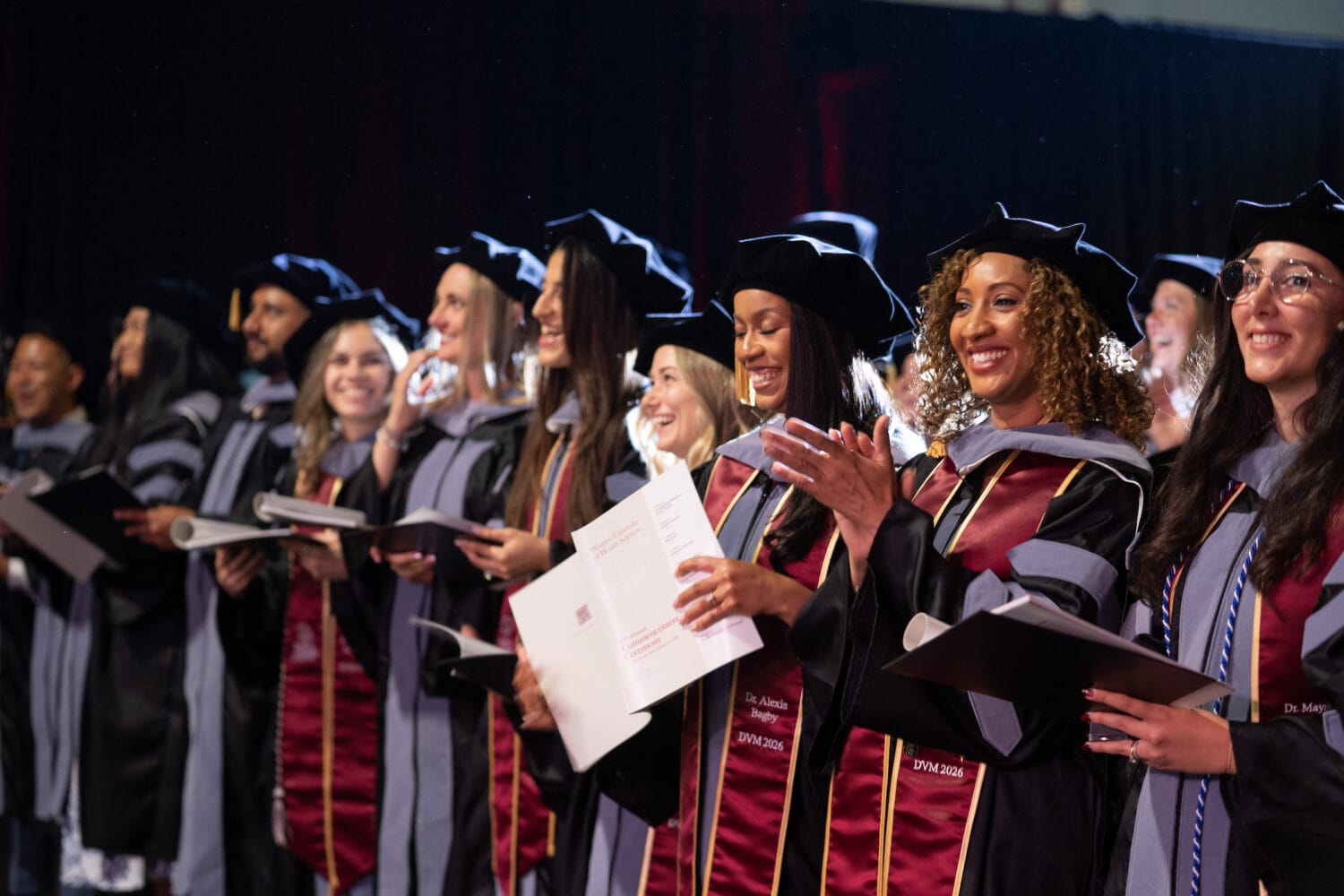
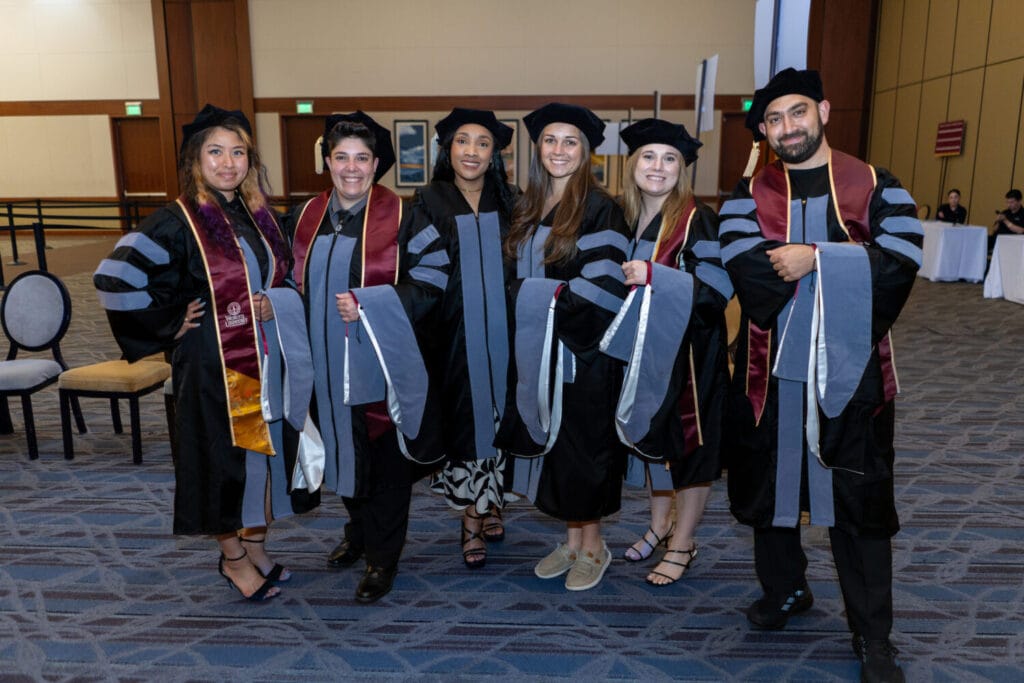
More than 100 new veterinarians climbed onto the stage during the 2026 Commencement for Western University of Health Sciences’ College of Veterinary Medicine on Wednesday, May 20, 2026. The ceremony represented a conclusion of sorts: the graduates leave the CVM prepared to practice. But the learning will certainly continue.
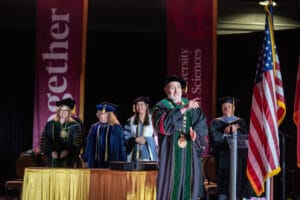
WesternU President Robin Farias-Eisner, MD, PhD, MBA, urged the new doctors to continue to gather knowledge as they enter the workforce or begin internships and residencies.
“As you move forward from this day, I encourage you to remain lifelong learners, to be courageous in your convictions, humble in your service, and steadfast in your commitment to justice and human dignity,” he said. “Today, you do not merely graduate. Today, you step more fully into your calling.”
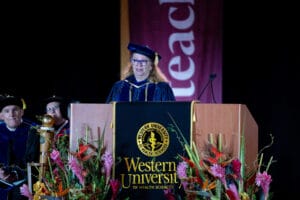
The continuous learning is all part of becoming a veterinarian, according to CVM Executive Dean Diane McClure, DVM, PhD, DACLAM.
“Somewhere along the way—through PBL sessions, clinical skills labs, and your clinical rotations—that shift happened,” said Dr. McClure. “You stopped thinking like students and started thinking like doctors.”
CVM welcomed 107 new doctors into the profession in ceremonies held at the Sheraton Fairplex Suites & Conference Center in Pomona, California, in a cavernous room filled with excited friends and family. Those supporters were crucial in helping develop those graduates, according to Dr. Farias-Eisner.
“None of this would be possible without the support of your families, friends, and loved ones,” he said. “Their unwavering support and sacrifices have been instrumental in bringing you to this momentous day.”
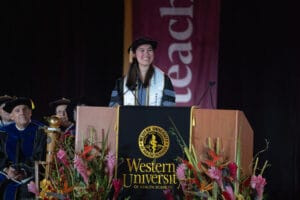
Melinda ‘Mindy’ Weinberg, DVM ’26, served as the graduate speaker for this year’s class. In a few short words she reminded her classmates of the four-year journey they were completing.
“I look into this audience and I see people whose paths to today included camping out in PBL (Problem-Based Learning) rooms, learning the coagulation cascade, parasite names in Latin, and the layers of the horse hoof,” she said.
“In this profession, equipped with this well-earned degree, regardless of where our paths take us, we will all be leaders,” Weinberg added. “I encourage you all to not just occupy this leadership position of veterinarian, but lead with purpose. To not just be a leader, but a good leader. It took a strong sense of ‘why’ to get this far, a purpose that will allow you to set the tone for how you and those around you respond to the challenges of our profession. Lasting, sustainable, positive change is possible and it starts with cognizant, empathetic, intentional leadership.”
Dr. Weinberg was among those with strong family support, and her family from Mercer Island, Wash., could not have been more proud to watch her collect her diploma.
Dr. Weinberg’s father, Ted Weinberg, said that his daughter wanted to become a veterinarian from an early age, and wrote a ninth-grade paper outlining her veterinary career goal. “Mindy was drawn to cats and wanted to know everything about them,” he recalled, noting that seven or eight generations of cats have lived in the family home, making them an obvious interest.
“She really blossomed at WesternU,” he added.
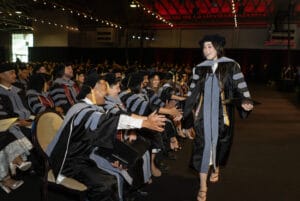
Dr. Weinberg’s path involved sampling a little—or a lot—of everything that the College of Veterinary Medicine had to offer, and serving in a variety of leadership roles in collegiate organizations. Her next stop is a small animal surgery internship at Wheat Ridge Animal Hospital in the Denver, Colo. area.
“I’m looking forward to learning a lot,” she said. “I really want to become the clinician I’m supposed to be. Continuing my learning, continuing to meet a lot of people. Continuing to grow and push myself.”
Roberta Bailey, DVM ’26, said the four years of veterinary school flew by. “I almost can’t believe we’re already here,” she said. “It came so quickly.”
Like Dr. Weinberg, Dr. Bailey gained insight into veterinary medicine both inside and outside of the classroom. She became heavily involved in the Street Dog Coalition, a volunteer organization providing free animal care for the area’s unhoused population. That work will continue to influence her as she begins her first job with a group of small area veterinary clinics owned by CVM alumna Rachel Nieu, DVM ’15.
“I learned that it is important to treat everyone with respect, regardless of their social or economic status,” Dr. Bailey said. “Sometimes we think that people who are unhoused shouldn’t have pets. I kind of thought that way too; if you can’t afford it, you shouldn’t have a pet. Working with the Street Dog Coalition and volunteering my time at various vaccine clinics has really made me realize that this is not true.
“People are struggling; it is not fair to treat people who may be down on their luck and maybe having a hard time affording veterinary care,” she added. “That really is important to me: bringing that care to them.”
While Dr. Bailey believes WesternU has trained her well, she said she will miss having the constant support of her professors as she begins her career.
“I have made some really great connections with faculty here,” she said. “I was always nice to just pop into their office, to talk to them about an event I was doing or just to get some general advice on anything. I’m going to miss that.”
CVM graduate George Kuesis, DVM ’26, also said he is going to miss the faculty guidance. He also is going to miss the support of his classmates.
“I really liked the team aspect of WesternU. I’ve met some really great friends here; I loved working so closely with my peers,” Dr. Kuesis said. “They really made it worthwhile for me.”
Dr. Keusis will be continuing his veterinary training with an internship at Steinbeck Peninsula Equine Clinic in Salinas, Calif.
The new veterinary graduates are entering a world where their skills and compassion are in unprecedented high demand.
Dr. Farias-Eisner took stock on that fact in his address to the graduating fourth-year students. He recited an assortment of statistics outlining the veterinary shortage that has gripped the nation, from the lack of large animal vets in farming communities to the need for companion animal care. He noted that the need for more veterinarians is clear.
“You are a blessing to the nation,” Dr. Farias-Eisner exclaimed. “You are the solution.”
Dr. McClure urged students to stay true to their path as they enter their careers. “Don’t forget the reasons why you became a veterinarian,” she said.