WesternU College of Graduate Nursing ranked among U.S. News & World Report’s Best Nursing Schools
by Rodney Tanaka
April 7, 2026
Read 1 mins
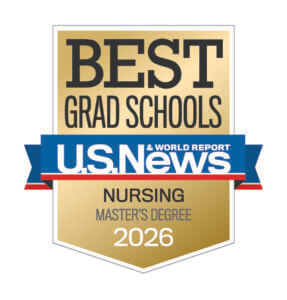 Western University of Health Sciences’ College of Graduate Nursing (CGN) is ranked among the 2026 Best Nursing Schools: Master’s by U.S. News & World Report, according to a report released April 7, 2026. Link: 2026 Best Nursing Schools: Master’s
CGN’s Master of Science in Nursing-Entry (MSN-E) program in Pomona, California, is ranked No. 45 (tied) in the nation. CGN has long stood on the foundation that a master’s degree should be the entry point for nursing, said CGN Dean Mary Lopez, PhD, MSN, RN.
“Very few programs in California, let alone the nation, have that philosophy,” she said. “This ranking is a great recognition of that approach. We’re so proud to be recognized for that. We’ve long believed that when we raise up one group of nurses, all of nursing raises up.”
There is a huge nursing shortage in Southern California and across the nation, Lopez said.
“There has never been a better time to be a nurse. We have been able to use our talents, our treasures and our faculty and staff to expand the program. We’ve gone from 75 students graduating every year to 100, putting more and more highly qualified, educated nurses who have leadership skills into our hospitals, clinics and public health departments to increase the health of our communities,” she said. “I really have to hand it to the team at the College of Graduate Nursing – the faculty, the staff, and then all our students. We’re all ambassadors of the program and it’s great that we are recognized for the high-quality program we have at WesternU.”
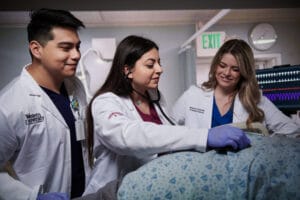
CGN developed an externship program that has been highly successful and well-received by students and the College’s community partners. MSN-E students with an affinity for a particular area of the hospital, such as the OR, ICU or pediatrics, receive additional training to help them pursue that interest.
All MSN-E students take the regular curriculum Monday through Thursday, and then a student interested in an emergency room externship, for example, will receive four hours of education with an ER expert on Friday.
“And then they do their clinical with a preceptor in the emergency department, so they’re directly applying what that expert just taught them,” Lopez said. “We’re giving them education that’s specialized to that area. That’s so exciting for our students. Our clinical partners love it because they get to know the students and teach them their way of nursing within those specialty areas in their hospital. This externship program is not done at every nursing school. That’s something that really sets us apart, and we’ve had really good outcomes with the Nursing Externship.”
CGN students are highly employable because they make those connections in the Nursing Externships.
“We’ll help nursing students by putting them in a clinical environment that they have affinity towards and connect them with people that may be helpful, and so that they can thrive in nursing and have just a joyous career doing what they love,” Lopez said. “It’s very satisfying for me as dean to watch the students grow in the areas that they want to grow in.”
CGN is introducing an MSN-E program in Lebanon, Oregon in fall 2027 to address the nursing shortage in Oregon. Just as the MSN-E program in Pomona is tailored for an urban setting with high tertiary needs, the MSN-E program in Oregon will focus on rural nursing needs. One strong component of the curriculum in Oregon will be behavioral health. In talking with chief nursing officers in the Willamette Valley, Lopez said the biggest need is ER nurses who know how to handle all emergencies and who can deliver babies.
“Many hospitals are closing their maternity units, so women are having to drive so much farther to get their prenatal care and for their delivery,” Lopez said. “They’re seeing more and more deliveries in the emergency department.”